
A generation ago, a Nashville cigar lounge filled its leather chairs by phone tree and humidor-side conversation. If you knew, you knew. If you didn't, you wandered in on a Tuesday and found three regulars, a jazz record, and a bartender polishing glasses. Today that same prospective member opens their phone, types cigar lounge near me, and decides whether to drive over based on what is on your event calendar this Thursday. Word-of-mouth still matters, but the website got promoted from optional to load-bearing - and the page doing the heaviest lifting isn't About or the humidor list. It's the calendar. That's why a purpose-built cigar lounge website event calendar CMS has become the most important tool behind the bar that no one behind the bar ever sees.
The calendar is the marketing. Everything else is just decoration.
What actually draws a guest to a private cigar lounge in 2026 isn't the wallpaper or the depth of the humidor - every serious lounge in our market has a deep humidor. It's the program: a Padron pairing with the distributor rep in town, a Davidoff release party, a member-only Pappy night, a Friday herf where the regulars show up, a holiday box-pickup. Every one of those is a website update. Every one needs a date, a vitola lineup, a pairing menu, a ticket count, and a photo from last year's version.
That cadence breaks most lounge websites. The site was built once by a designer who delivered something handsome, and the calendar froze in amber the day the keys got handed over. Six months later the "upcoming events" page still lists a Father's Day herf from last June, and the next would-be member closes the tab. When we rebuilt Briarwood's site, the brief was simple: the calendar has to move at the speed of the program, not the speed of a quarterly designer retainer.
That's what brought us to Workspace CMS. The pitch is unusually direct for our industry: send a ticket; we ship the change. No page-builder fighting, no learning a content model, no "can you wait until next sprint?" The lounge manager emails the event details - wrapper, binder, ligero blend notes, the bourbon pairing, the seat count - and the page is live the same week. Usually faster. If you want to see what that looks like across other hospitality and membership tenants before you commit, the live demo gallery walks through twenty-plus builds in similar shapes.
What we actually wanted from a cigar lounge website designer
When we ran the agency search, we weren't looking for a portfolio of glossy hospitality sites. We had three brochure-grade redesigns sitting in our drafts folder already. We were looking for a cigar lounge website designer who would still be on the hook after launch - someone whose business model assumed that a hospitality program publishes new content every single week, not once a quarter.
That filter cut the candidate list down fast. Most agencies bill a build, hand off a CMS login, and go quiet until the next redesign. Workspace CMS sells the opposite: the build is the first month, and the next thirty-six months are a managed-edit subscription. As a private club web design agency arrangement that fits the rhythm of a lounge program - a Davidoff release one week, a holiday box pickup the next, a distributor pairing the week after - it's a much closer match than the traditional retainer model.
The Page Editor and SEO Sidebar that actually get used
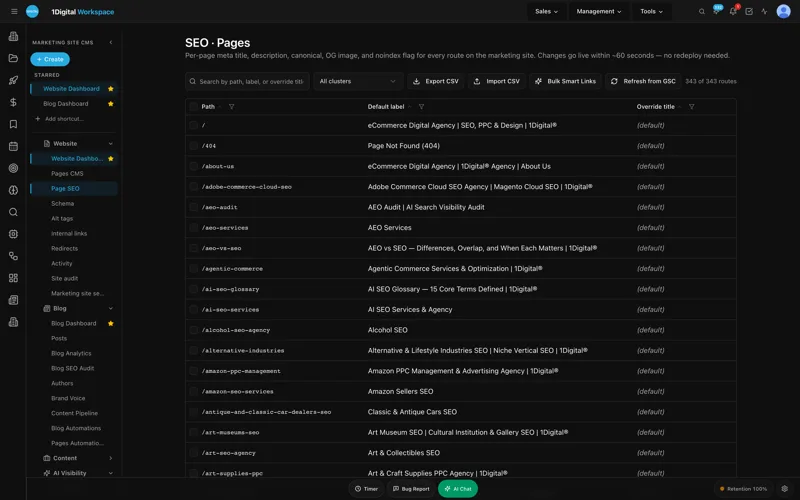
Here's the part that surprised us. We assumed the managed-edit promise meant we'd never touch the admin ourselves, and for the most part that's true - the manager doesn't, the concierge doesn't, the owner doesn't. But our marketing contractor logs in two or three times a week, and what she uses isn't the page tree or the media library. It's the Page Editor with its permanent SEO Sidebar, which sits next to the body copy and shows meta title, meta description, slug, structured data, internal-link suggestions, and a real-time readability and keyword scan as you type.
For event pages that means she can draft a Tatuaje pairing-night announcement, watch the SEO panel flag a missing meta description, fill it in, see the structured event markup populate automatically, and submit the ticket for publish - all in one screen. No tabbing between an SEO plugin and the body editor. No "we'll fix the meta later." That single feature changed how seriously we treat event-page SEO, which translated directly into more organic walk-ins for searches like cigar lounge Nashville Friday herf.
Why "unlimited managed changes" is the right shape for a lounge
Most CMS pricing assumes you'll touch your site a few times a quarter. A cigar lounge with a real program touches it weekly, sometimes daily - a distributor confirms Wednesday afternoon, the pairing menu needs to be live by Thursday noon. Paying a designer hourly doesn't work. Doing it yourself in a clunky page builder doesn't either - the manager's time is on the floor with members, not learning a CMS UI.
Unlimited managed changes solve that. Briarwood ships, in our experience, twelve to twenty event-page edits per month - calendar additions, lineup tweaks, photo refreshes, pairing-menu updates. At a per-change agency rate that runs into thousands monthly. On a managed CMS plan it's flat-rate, and turnaround is measured in days.
UNLIMITED MANAGED CHANGES
Send a ticket. We ship the change.
Every Workspace CMS plan includes unlimited managed CMS edits. Essentials ships in 4 business days. Growth ships in 2. Premium ships in 12–24 hours. No per-edit fees. No "open a Jira" overhead. Every new pairing night, every distributor lineup swap, every wrapper-and-binder copy revision your compliance reviewer flags - describe what you need and our team builds it on your live site.
Automations and the Content Pipeline Board behind a monthly calendar refresh
The other half of running a real program is forecasting it. Briarwood publishes a forward-looking calendar three to four weeks out, and every Sunday night the public calendar page gets a sweep - old events archived, new ones promoted, the "this month at Briarwood" digest regenerated. That used to be a Sunday-night chore for the manager. Now it's an Automation we configured once with the Workspace CMS team and forget about.
Distributor-led pairing nights - the Davidoffs, Tatuajes, Padrons - get their own lane on the Content Pipeline Board. Each event lives as a card that moves from idea to brief to draft to review to scheduled to published. Our distributor reps can see what's coming, our concierge sees what's locked, and our compliance reviewer sees what needs a second pair of eyes before it goes live. As a lifestyle lounge website company workflow it's the first kanban we've stuck with for more than a quarter, and the reason is that it isn't a separate tool - it's the same admin where the page lives.
RSVPs, membership inquiries, and forms that convert
An event page without a working RSVP is a flyer. The second half of our rebuild was the form layer. Every event detail page has a tailored RSVP form embedded directly through the Page Editor - seat count, member or guest, dietary notes, preferred vitola from the night's lineup. The membership inquiry form is separate, longer, and routes to our concierge inbox with the source page captured.
Workspace CMS handles all of that as part of the managed change flow. We ticketed the original form spec; they shipped it. When we wanted to add a "how did you hear about us" picklist after a holiday box pickup pulled in a wave of new prospects, we ticketed that too; it was live in two business days. The forms feed our CRM and our reservation system, but more importantly they feed a clean record of which events fill, which don't, and which ones we should run again next quarter. The full managed-change workflow is documented step-by-step on the marketing site if you want to walk through it before you talk to anyone.
FTC, FDA CTP, and why "reviewable copy" matters
Every lounge operator learns this quickly: tobacco marketing copy isn't freeform. The FTC and the FDA's Center for Tobacco Products have specific guardrails around health claims, youth-targeted imagery, and unsubstantiated language. Your counsel will tell you the specifics, but the practical implication is that every piece of public copy gets read by a second pair of eyes before it ships. The line matters, and it changes.
The Workspace CMS workflow is built around exactly this kind of reviewability. Changes go through a ticketed queue with an audit log - who asked for what, what shipped, when. If our compliance review flags a phrase, we ticket the correction and it's revised the same day. The Owner / Editor / Viewer roles plus audit log mean the manager can request edits without holding publish permissions, and our compliance reviewer can see exactly what went live without scrolling through a designer's Slack DMs. The Theme & Brand Voice module also locks the AI-assisted copy tools to our actual voice and our reviewed phrasing, so the AI Blog Generator drafts for new-arrival posts don't drift into language our counsel hasn't seen.

The Site Audit run we do before every release party
Before a flagship event - a release party, a holiday gala, anything we expect to draw a wave of first-time visitors - we run a Site Audit on the event page and the three pages most likely to receive its overflow traffic. The audit covers more than forty checks per page: broken links, missing alt text, oversize images, structured-data validation, Core Web Vitals, redirect-chain detection. One-click remediation handles most of them. The handful that need a judgment call get ticketed.
This sounds fussy until you've watched a release-party page get shared two hundred times in a private Telegram group and the page itself is dragging a four-second LCP. We don't ship release pages anymore without an audit pass. As an operating habit it's worth more than any single SEO tactic we've adopted - and it pairs naturally with the AI Meta Rewriter sweep we run quarterly to keep meta titles and descriptions fresh across the archive of past-event recap pages.
How a cigar lounge website event calendar CMS maps to the pricing tiers
Workspace CMS publishes three tiers, and the right fit for a lounge depends almost entirely on update frequency, not catalog size.
- Essentials at $89/month is self-managed with a 4-business-day SLA on requests. Reasonable for a one-room lounge with a quiet program - say a single monthly herf and not much else.
- Growth at $199/month is the tier most lounges land on, and it's where Briarwood sits. Unlimited content edits, image swaps, location updates, blog posts, with a 2-business-day SLA and same-business-day on blockers. Includes Google reviews built into your site, which matters more than people realize for the "cigar lounge near me" search that fills walk-ins.
- Premium at $449/month is white-glove with a 12 to 24 hour change SLA. The right call for multi-location operators or lounges with a heavy event tempo - three or four programmed nights a week.
A full tier-by-tier breakdown lives on the pricing page, but for most independent lounges Growth is the realistic answer. The catalog is modest, the update frequency is high, and the Google reviews built into your site pay for themselves in walk-ins. As a membership lounge marketing agency arrangement it's the rare hospitality retainer where the math actually pencils out month over month - the $199 tier replaces what used to be a $1,800 quarterly designer invoice plus a fractional SEO contractor. If you want to compare your own program against the pricing matrix in a working call, book a strategy session and bring the last sixty days of event-page edits with you.
What two weeks of launch and same-week edits actually looks like
Most clients launch within two weeks, which sounds like marketing copy until you watch it happen. Our rebuild brief went in Monday; the site was on staging the following week. The first real event we tested was a Tatuaje pairing - email the lineup Tuesday morning, page live Wednesday afternoon, RSVPs open Thursday, event Saturday. Twenty-eight seats sold, fourteen of them first-time guests who found the page on Google. That's the loop. Similar launch timelines and post-launch cadences are documented in the hospitality case studies if you want to compare notes against another operator's program before you commit.
The Cigar Lounge Website Event Calendar CMS That Keeps Up FAQ
How fast can a new event page actually go live?
On the Growth tier, two business days is the standard SLA, and same-business-day for blockers. In our experience the typical event-page edit ships well inside the SLA - usually the same day if it comes in before noon. Send the wrapper / binder / ligero notes, the pairing, the seat count and a header image, and you're live.
Can we keep our existing reservation or POS system?
Yes. The CMS owns the public site, the event pages, the RSVP forms, and the blog. The forms can route to whatever backend you already use - most lounges keep their existing reservation platform and member CRM, and the website simply hands off cleanly.
Is there a separate humidor or inventory module?
The CMS handles content pages, not real-time inventory. Most lounges run a curated "now in the humidor" page that gets refreshed weekly or biweekly - which fits the managed-edit workflow perfectly. If you need live SKU-level inventory, that's a different tool, but very few lounge websites actually want it.
What about SEO for tobacco-adjacent businesses?
Standard SEO tools work normally - page-level meta, structured data, redirect manager, sitemap and robots editors. Paid search has restrictions on tobacco categories, which is a separate conversation, but organic search for terms like cigar lounge Nashville or private cigar club near me is open and competitive. A clean event calendar with structured event markup is genuinely powerful here.
Who actually does the editing on the managed plans?
Real humans at 1Digital, supported by AI tools. The promise is real humans, real AI tools, real changes shipped fast - not a chatbot pretending to be a CMS. You send a ticket, a person triages it, the change ships, and the audit log records what happened.
If your cigar lounge website event calendar CMS is the chokepoint between a programmed Saturday herf and a half-empty room, the fix isn't a bigger marketing budget. It's a CMS that ships event-page edits at the same speed your program moves. Walk through the workflow with our team and bring next quarter's calendar - we will show you exactly how the program ends up on the page.
