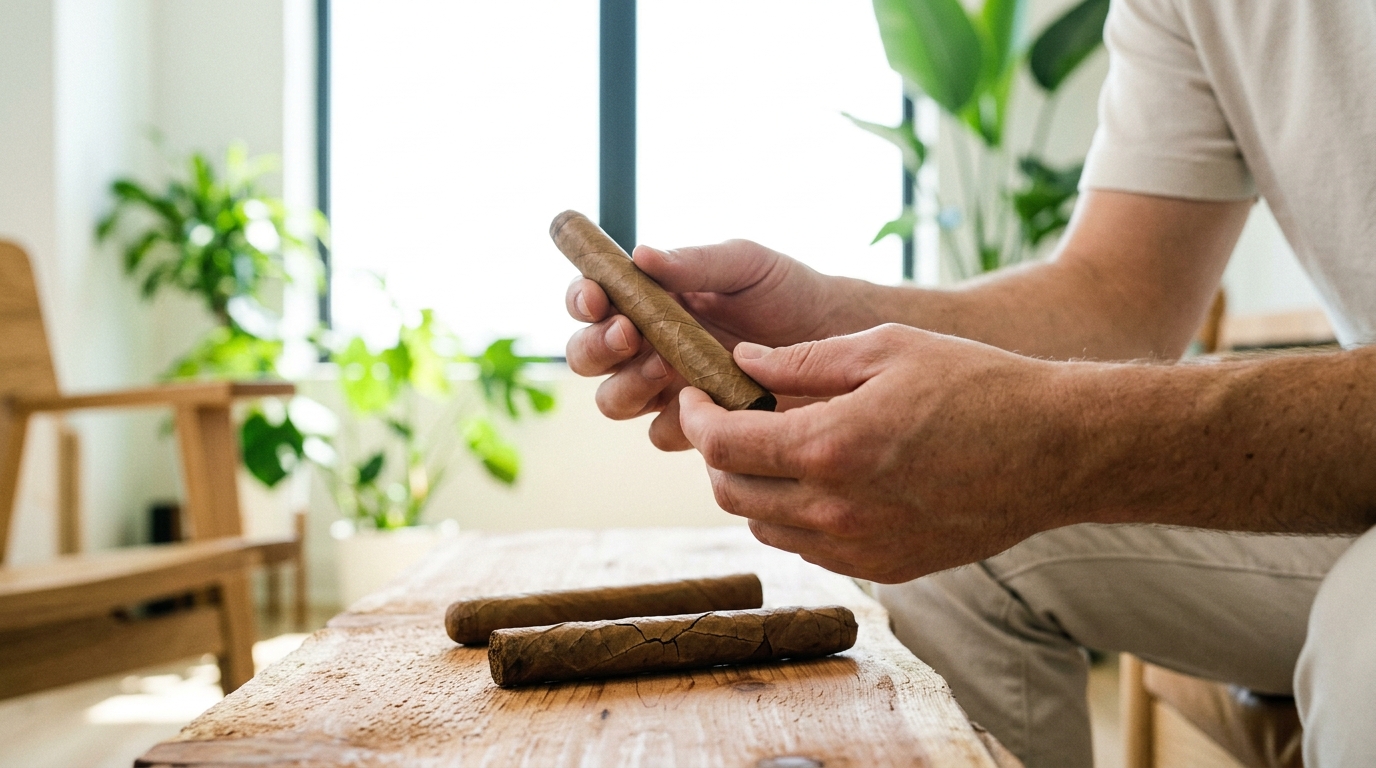
Humidity is the single most important variable in cigar storage. Store your cigars at 65–72% relative humidity (RH) and 65–70°F, and they stay smokeable for years. Drift outside that range - in either direction - and you're looking at cracked wrappers, bitter draws, mold, or tobacco beetles.
This guide breaks down exactly what humidity does to a cigar, what happens when it goes wrong, and how to dial in your humidor so your collection stays in peak condition.
Why Humidity Matters More Than Any Other Factor
A cigar is made of dried, fermented tobacco leaves - filler, binder, and wrapper - rolled together and aged. That tobacco is hygroscopic, meaning it constantly exchanges moisture with its surrounding environment. When the air around your cigars is too dry, the leaves give up moisture and shrink. When the air is too wet, the leaves absorb it and expand.
The problem is that the filler, binder, and wrapper are often different tobacco varieties from different regions. They absorb and release moisture at slightly different rates. That differential movement is what causes cracked wrappers, plugged draws, and uneven burns - the most common complaints from cigar smokers who skip proper storage.
Temperature amplifies every humidity-related risk. At 75°F and above, tobacco beetle eggs - which are present in virtually all cigars - hatch and bore through your entire collection. Keeping your humidor under 70°F isn't optional if you care about your cigars.
The Ideal Range: 65–72% RH at 65–70°F
The most widely accepted storage target is 68–70% RH at 68–70°F, often called the "70/70 rule." That's a solid starting point, but experienced collectors often prefer the lower end of the humidity range - 65–68% RH - for a few reasons:
- Lower burn temperature: Drier tobacco burns cooler and more evenly.
- Reduced mold risk: Mold thrives above 72% RH, especially when airflow is limited.
- Better draw: Slightly drier filler draws more freely than saturated tobacco.
- Enhanced flavor: Many premium cigars from Nicaragua and the Dominican Republic are blended to smoke at 65–68% RH.
Higher-humidity storage (70–72%) works well for Cuban cigars in particular, which were historically made for markets with higher ambient humidity. Know your cigars and adjust accordingly.
What Happens When Humidity Is Too Low
Below 60% RH, cigars begin to dry out noticeably within one to two weeks. The symptoms progress in stages:
- Wrapper cracks: The outer leaf dries and contracts faster than the filler, creating hairline cracks or full splits along the seam.
- Harsh smoke: Dry tobacco burns hotter and faster, amplifying bitter and astringent compounds in the leaf.
- Loose draw: Shrunken filler creates gaps and channels inside the cigar, making the draw feel airy and uncontrolled.
- Loss of aroma: Essential oils in the tobacco evaporate with moisture, stripping the cigar of complexity and nuance.
- Structural damage: At 50% RH or below, cigars become brittle enough to crumble when you remove the band or cut the cap.
The good news: cigars dried out to 60–65% RH can usually be recovered. Place them back in a properly humidified environment and let them slowly rehydrate over two to four weeks. Never try to speed up the process by placing them near a moisture source directly - rapid rehydration causes the wrapper to crack just as surely as rapid drying does.
What Happens When Humidity Is Too High
Over-humidification is just as damaging, and the consequences are often irreversible:
- Mold growth: Above 72% RH with limited airflow, bluish-white mold appears on wrappers within days. Mold penetrates the leaf and destroys flavor compounds permanently.
- Plugged draw: Saturated filler swells and compresses the internal air channel, making the cigar nearly impossible to draw through.
- Uneven burn: Wet tobacco doesn't combust evenly, leading to canoeing (one side burning faster) and constant relights.
- Ammonia off-gassing: Very wet tobacco accelerates fermentation, releasing ammonia that gives the smoke a sharp, chemical harshness.
- Beetle risk from temperature spikes: High humidity combined with any temperature spike above 72°F creates ideal hatching conditions for tobacco beetles.
Note: white, powdery spots that wipe off cleanly are often plume (also called bloom) - crystallized oils, not mold. Plume is harmless and actually indicates proper aging. Mold has a fuzzy texture and a musty smell. When in doubt, isolate the affected cigars immediately.
Humidor Types and Their Humidity Performance
Humidor Type Capacity Humidity Stability Best For Desktop wood humidor 25–150 cigars Moderate - sensitive to room conditions Casual collectors, small collections Electronic humidor cabinet 150–1,000+ cigars High - thermoelectric cooling, digital control Serious collectors, aging Tupperdor (airtight container) Varies Very high - near-zero moisture loss Budget-conscious storage, travel Coolidor (cooler converted to humidor) 500–2,000+ cigars Very high - excellent insulation Large collections, bulk aging Walk-in humidor room Unlimited Excellent with HVAC integration Commercial retailers, extreme collectorsHow to Season a New Humidor Correctly
An unseasonated wood humidor will pull moisture directly out of your cigars. Cedar absorbs humidity before the cigars do, so you need to season the wood first.
- Wipe the interior cedar walls with a clean, barely damp (not wet) cloth. Never use distilled water pooled inside - it warps the wood.
- Place a small dish of distilled water inside the humidor with your humidification device charged to 70% RH solution.
- Close the lid and wait 24–48 hours. Check the RH with a digital hygrometer.
- Repeat until the humidor stabilizes at your target RH without the internal dish. This usually takes two to three cycles over a week.
- Calibrate your hygrometer before trusting it. Use the salt test (75% RH) or a two-point digital calibration kit.
Humidification Methods Compared
- Floral foam devices (green sponge): The cheapest option, least reliable. They release moisture in unpredictable bursts and can create localized over-humidity. Replace them.
- Silica gel beads (two-way): The current standard for desktop humidors. Brands like Boveda (62% or 69% packs) and Integra Boost release and absorb moisture to maintain a target RH passively. Boveda 69% packs are accurate to ±1% RH.
- Electronic humidifiers: Fan-driven units with reservoirs. Necessary for cabinet humidors above 150 cigars. Require distilled water to prevent mineral buildup.
- Passive bead jars: Glass jars filled with silica gel charged to a specific RH. Cost-effective for coolidors and tupperdors.
For most collectors storing under 200 cigars, Boveda 69% packs are the easiest, most reliable solution available. Replace them when the pack feels rigid (fully depleted), which typically happens every two to four months depending on humidor seal quality.
Daily Habits That Protect Your Investment
Even a perfect humidor setup fails if your habits work against it. Keep these practices consistent:
- Open the humidor no more than once or twice per day to minimize moisture exchange with room air.
- Rotate cigars every few weeks - top rows to bottom - so exposure to the humidification source stays even.
- Keep the humidor away from air conditioning vents, heating registers, and direct sunlight.
- Never store flavored cigars with unflavored ones - flavored cigars leach their aromas into neighboring tobacco permanently.
- Log your RH and temperature readings weekly, especially through seasonal transitions when room conditions swing most dramatically.
What is the ideal humidity level for storing cigars?
Store cigars at 65–72% relative humidity and 65–70°F. Most experienced collectors target 68–70% RH as a baseline, though premium Nicaraguan and Dominican cigars often smoke best at the lower end of that range - around 65–68% RH.
Can I recover cigars that have dried out?
Yes, if the wrapper hasn't cracked and the cigar dried to no lower than roughly 55–60% RH. Place the dried cigars in a properly humidified environment and let them rehydrate slowly over two to four weeks. Rapid rehydration causes wrappers to crack, so patience is essential.
How do I tell the difference between mold and plume on a cigar?
Plume (bloom) is a white, powdery crystallization of essential oils. It wipes off cleanly with a dry finger and has no odor. Mold is fuzzy or filamentous, often bluish-white or green, and carries a musty smell. Mold penetrates the leaf and ruins flavor - isolate affected cigars immediately.
How often should I replace Boveda humidity packs?
Replace Boveda packs when they feel completely rigid, which signals full depletion. In a well-sealed desktop humidor, this typically occurs every two to four months. Poor seals, frequent opening, or very dry ambient air will shorten that cycle. Keep one or two spare packs on hand for immediate replacement.
Is a tupperdor as effective as a cedar humidor?
For humidity stability, a tupperdor (airtight food-safe container with silica gel or Boveda packs) outperforms most entry-level wooden humidors because the near-perfect seal loses almost no moisture. The trade-off is that cedar's antimicrobial properties and ability to absorb excess humidity are absent. Many collectors age long-term in coolidors or tupperdors and transfer cigars to cedar humidors for short-term access.
