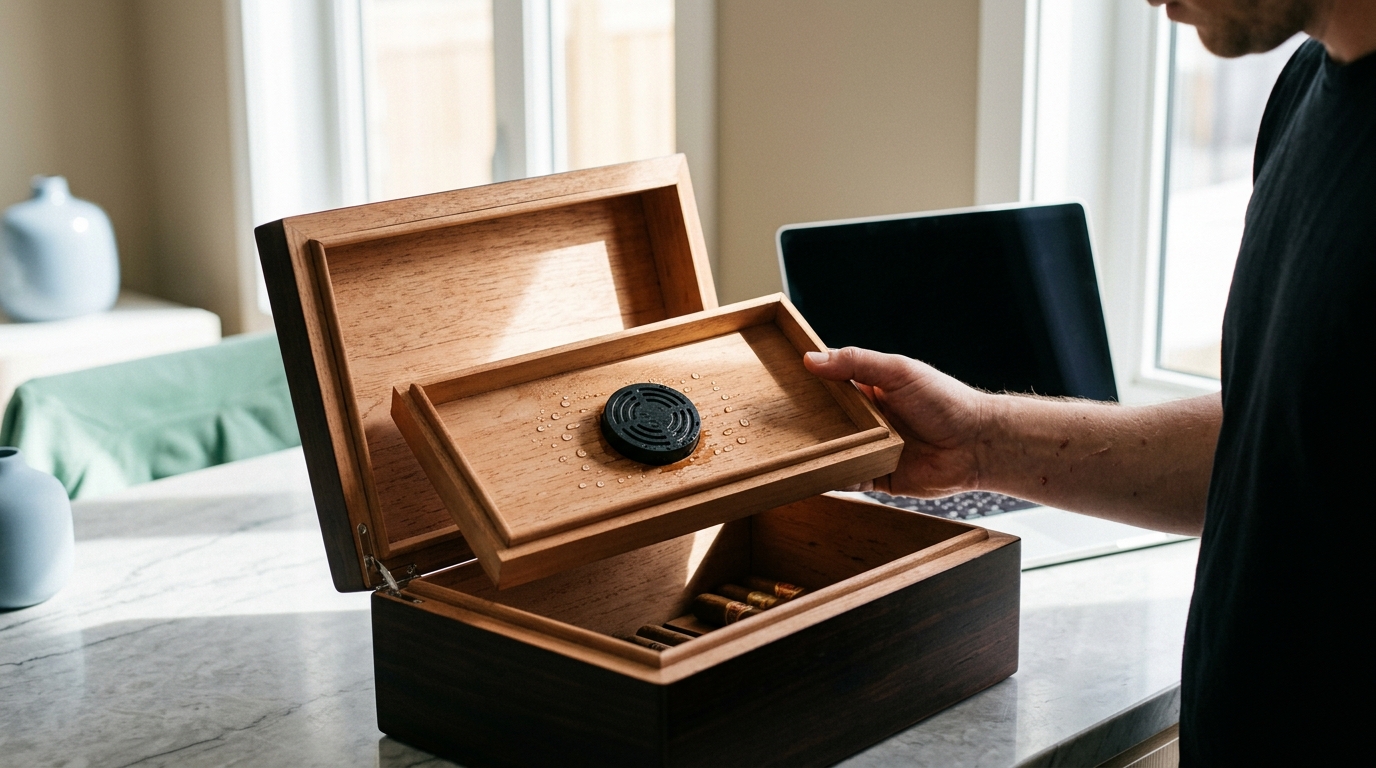
A quality humidor maintains 65–72% relative humidity and 65–70°F (18–21°C) consistently - those two numbers determine whether your cigars age gracefully or turn to dust. Every other feature on this list exists to protect those conditions.
Whether you're storing five cigars or five hundred, the difference between a good humidor and a bad one comes down to materials, seals, humidification systems, and hygrometer accuracy. Here's exactly what to evaluate before you buy.
Spanish Cedar: The Non-Negotiable Interior Wood
The interior lining of any serious humidor should be Spanish cedar (Cedrela odorata). This wood earns its place for three specific reasons:
- Moisture absorption and release: Spanish cedar absorbs excess humidity and releases it back when levels drop, acting as a natural buffer against swings.
- Tobacco beetle deterrence: The wood's natural oils repel Lasioderma serricorne, the tobacco beetle that can devastate a collection if storage temperatures exceed 73°F.
- Flavor enhancement: Long-term aging in Spanish cedar imparts subtle, complementary aromatic notes that premium cigar makers specifically design their blends to receive.
Avoid humidors lined with generic "cedar," mahogany veneer, or composite wood. These materials don't regulate moisture and can introduce off-flavors. Check the product listing for "solid Spanish cedar" - not cedar-scented, not cedar-finished.
The Seal: Where Most Budget Humidors Fail
A humidor is only as good as its seal. Lift the lid and let it drop from about two inches above the closed position. A well-sealed humidor will slow noticeably in the last half-inch due to air compression - this is called the "puck test" or the "dollar bill test" (slide a bill into the closed seam; you should feel real resistance pulling it out).
Poor seals cause humidity to escape faster than any humidification device can compensate. Signs of a bad seal include:
- Visible daylight through the closed lid corners
- A lid that slams shut with no resistance
- Warped or uneven contact surfaces along the gasket line
- Thin felt or foam weather stripping instead of a solid wood-to-wood contact surface
High-end desktop humidors from brands like Davidoff, Elie Bleu, and Daniel Marshall use precision-machined wood-to-wood contact without foam gaskets, which degrade over time. For cabinet humidors, look for magnetic closures combined with solid wood contact - this combination maintains an airtight seal for years.
Humidification Systems: Passive vs. Active
How a humidor adds moisture to its interior separates entry-level boxes from serious storage solutions.
System Type How It Works Best For Maintenance Passive Foam/Floral Foam Sponge soaked in distilled water or propylene glycol solution Starter humidors under 50 cigars Refill every 2–4 weeks Beads (Boveda or loose beads) Salt-crystal packs that absorb and release moisture at a fixed RH Desktop humidors, precise control Replace packs every 2–6 months Electronic/Active Fan-driven unit with a water reservoir and digital controls Cabinet humidors, 100+ cigars Refill reservoir, clean fan quarterly Two-Way Humidity Packs (Boveda 69 or 72) Pre-calibrated packets that absorb excess and emit moisture Any size; travel humidors Replace when packet hardensBoveda two-way packs are widely regarded as the most foolproof solution for desktop humidors holding under 150 cigars. They eliminate the overshoot problem - where a passive sponge dumps too much moisture after a refill - and require zero calibration.
Hygrometer Quality: Analog vs. Digital
Your hygrometer is your dashboard. An inaccurate hygrometer is worse than no hygrometer because it gives you false confidence. The three things to evaluate:
- Accuracy tolerance: Look for ±1–2% RH. Most analog hygrometers shipped with entry-level humidors carry ±5–7% tolerance, which means your cigars could be sitting at 60% or 79% while the dial reads 70%.
- Calibration ability: The best digital hygrometers - Caliber IV, Inkbird IBS-TH2, and Cigar Oasis models - allow user calibration via a salt test. If a hygrometer can't be calibrated, replace it.
- Placement: Mount the hygrometer on the side wall, not the lid. Lid placement gives readings from the least-representative zone in the humidor.
Calibrate any new hygrometer before trusting it. The salt test (sealed bag with saturated salt solution at 75.3% RH for 8 hours) confirms accuracy within 1% and costs nothing but time.
Construction Quality and Exterior Materials
The exterior of a humidor serves two functions: aesthetics and insulation. Thicker walls retain temperature and slow humidity loss. Look for:
- Wall thickness of at least ¾ inch on desktop models - thinner walls lose temperature stability in rooms with AC or heating cycles.
- Solid wood or lacquered wood construction over MDF (medium-density fiberboard). MDF warps with humidity exposure and eventually breaks the seal.
- Piano-hinge quality: Brass hinges should move without play or wobble. Cheap hinges allow lid torque that breaks the seal at the corners over time.
- Lock mechanism: Not strictly necessary for humidity control, but a well-fitted latch keeps the lid seated evenly and prevents accidental opening.
Capacity: Buy Larger Than You Think You Need
The single most common mistake new humidor buyers make is underestimating capacity. A 50-count humidor realistically holds 35–40 cigars once you account for airflow, spacing, and the humidification device. Industry sizing is almost always optimistic.
As a rule: buy a humidor rated for twice your current collection. Cigars age better with company - a half-empty humidor is harder to keep at stable humidity than a well-stocked one because there's more dead air volume relative to wood and leaf mass.
Seasoning: A Step Most Buyers Skip
Before a new humidor stores a single cigar, it must be seasoned. Unseasoned Spanish cedar will pull moisture aggressively from cigars as it hydrates, causing wrapper cracking and dryout. Seasoning takes 24–72 hours and requires nothing more than a small dish of distilled water (never tap water) placed inside the closed humidor. Repeat once if the interior drops below 70% RH after removal of the dish.
Never wipe cedar interior walls with wet cloths - this raises the grain, warps the wood, and introduces mold risk. Distilled water in an open dish is the correct method.
Red Flags to Avoid When Buying
- Glass-top humidors (UV light degrades tobacco; glass conducts temperature changes rapidly)
- Humidors that arrive pre-humidified (the factory sealed humidity is never reliable)
- Interior cedar that smells of paint, finish, or chemical sealant
- Analog hygrometers glued in place with no removal access for calibration
- Brands that don't specify the interior wood species in their product descriptions
What humidity level should I maintain in my humidor?
Maintain 65–72% relative humidity for most cigars. Lighter Connecticut-wrapper cigars often prefer the lower end (65–68%), while full-bodied Maduros and long-aging cigars benefit from 69–72%. Never exceed 75% - mold and tobacco beetles thrive above that threshold.
How often do I need to refill my humidification device?
It depends on the system and the seal quality. Passive sponge devices need refilling every 2–4 weeks. Boveda two-way packs last 2–6 months depending on how often the humidor is opened and the ambient dryness of the room. Electronic units require reservoir refills every 1–3 weeks for large cabinets.
Can I use tap water in my humidor?
No. Tap water contains minerals and chlorine that clog foam humidifiers, leave calcium deposits on Spanish cedar, and can introduce bacteria. Always use distilled water or a purpose-made propylene glycol humidification solution. Propylene glycol (50/50 solution) has the added benefit of self-regulating at approximately 70% RH.
What's the difference between a 50-count and a 100-count humidor beyond size?
Beyond capacity, larger humidors typically have greater humidity stability because the larger mass of wood and tobacco acts as a buffer against environmental changes. A 100-count humidor with 80 cigars inside will recover from a door-open event faster than a 50-count humidor with 40 cigars. Larger units also justify higher-quality humidification and hygrometer hardware, which improves long-term storage outcomes.
How do I know if my humidor seal has failed?
Three reliable indicators: your hygrometer reads below 63% despite a functional humidification device, you need to refill the humidifier more than twice as often as normal, or you can see light through the seam when the humidor is closed in a dark room. A warped lid - common in humidors stored in rooms with large temperature swings - is the most frequent cause of seal failure and often requires professional re-fitting or replacement.
